yipalan
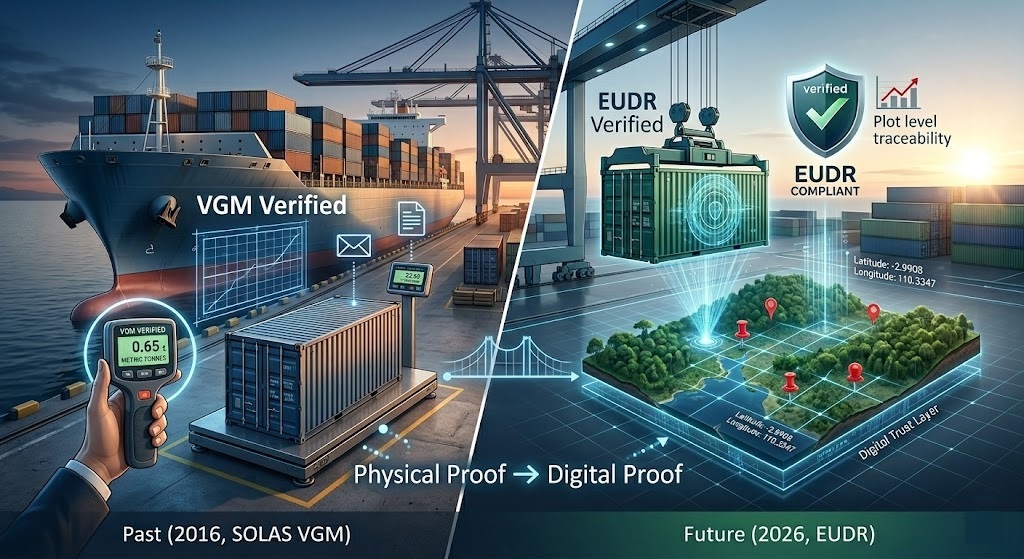
I still vividly remember the atmosphere in the shipping industry leading up to July 2016. Anxiety was everywhere as the SOLAS VGM (Verified Gross Mass) mandate approached its go‑live date. For those who weren’t part of the industry then, VGM was a global safety amendment introduced by the IMO, requiring that every packed export container have a verified weight before being loaded onto a vessel. The goal was simply to prevent maritime accidents and vessel instability caused by incorrectly declared cargo weights.
When I first entered the supply chain industry, I was tasked with delivering solutions to meet these new requirements. In those days, intelligence in logistics meant replacing paper‑driven assumptions with synchronized digital data. We had to bridge the gap between shippers, weighbridges and carriers to ensure that weight data moved faster than the physical cargo.
I feel that same “Day Zero” tension again. The acronym has changed to EUDR (EU Deforestation Regulation), but the structural challenge is strikingly familiar. In short, the European Union now requires that any product entering its market, specifically commodities like rubber, wood, coffee, cocoa, soy, and palm oil, must prove it did not contribute to forest degradation. If the SOLAS VGM era was about verifying the physical weight of the box, the EUDR era is about verifying the ethical origin of the goods inside it.
While the two regulations feel like mirrors of one another, the world has evolved significantly. We are no longer just digitizing paper; we are now operating in a hyper-connected ecosystem where precision is the only currency. EUDR demands exact geolocation data, latitude and longitude, for the specific plot of land where raw materials were harvested. While large and medium enterprises face a hard deadline in December 2026, smaller operators have a narrow window until June 2027 to adapt. Non-compliance is no longer just a logistical delay; it carries the risk of fines up to 4% of an operator’s annual EU-wide turnover.
To equip ourselves for this change, we must apply the lessons learned from the VGM rollout. We cannot treat compliance as a separate administrative silo; it must be baked directly into our Shipping Instructions and Digital Workflows. Just as we once built a digital bridge for weight data, we must now build a Digital Trust Layer for environmental data. By leveraging established data standards and scaling our digital services we can transform this regulatory burden into a competitive advantage. I have seen the industry transform before, and I am confident that those who embrace an intelligent, data-driven approach today will be the ones leading the market in 2027.
#EUDR #VGM #IoT #Tracking #ActNow #GlobalTradeCompliance #SupplyChainRegulation